Frequently Asked Questions
The most-asked questions about extinct archosaurs.
What exactly are archosaurs?
Archosaurs are a clade of diapsid reptiles that first diversified in the Late Triassic, encompassing dinosaurs, pterosaurs, and their close relatives. The name literally translates to 'ruling reptiles,' a nod to their roughly 160-million-year tenure as the dominant land vertebrates.
What major lineages fall under the archosaur umbrella?
The group splits into Pterosauria (the flying reptiles) and a sister clade that contains both Dinosauria and the crocodylomorphs (crocodiles, alligators, and their extinct relatives). Triassic forms like rauisuchians and aetosaurs are also nested within this broader archosauriform radiation.
When did archosaurs first appear, and how long did they dominate?
The earliest archosauriform fossils date to roughly 245 million years ago in the Late Triassic. They held the top-predator and dominant-herbivore niches on land for about 160 million years, until the end-Cretaceous mass extinction removed most of them.
What anatomical feature defines an archosaur?
The diagnostic trait is the antorbital (preorbital) fenestra, a bony opening in the skull positioned between the eye socket and the nostril. This opening, combined with a single large temporal fenestra on each side of the skull, sets archosaurs apart from other diapsid reptiles.
What is the closest living relative of extinct archosaurs?
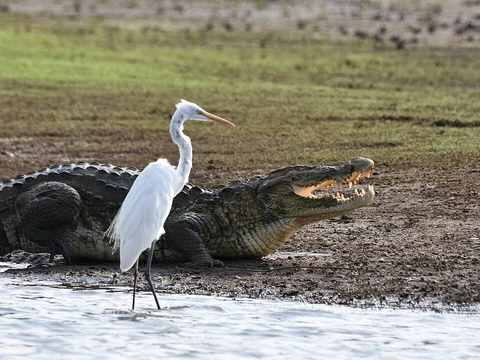
Crocodilians—crocodiles, alligators, caimans, and gharials—are the only surviving members of the archosaur clade. They are the sister lineage to the extinct dinosaur and pterosaur branches, making them the closest living cousins of T. rex and Pteranodon.
What caused the extinction of non-avian archosaurs?
The end-Cretaceous (K-Pg) mass extinction around 66 million years ago, widely attributed to a large asteroid impact in what is now the Yucatán Peninsula, eliminated all non-avian dinosaurs, pterosaurs, and large marine archosaurs in a single catastrophic event. Only small, ground-dwelling birds survived to become today's avian lineage.
What are some of the most famous archosaur fossils?
Tyrannosaurus rex, Velociraptor, and Pteranodon are among the most widely recognized names in popular culture, while Triassic giants like Postosuchus and the small Euparkeria anchor the earlier part of the lineage. These specimens appear frequently in both peer-reviewed literature and mainstream media.
Where can a newcomer start learning about archosaur paleontology?
A general vertebrate-paleontology textbook or the open-access educational pages of institutions such as the Smithsonian or the Natural History Museum in London make solid first stops. From there, dedicated monographs on dinosaurs, pterosaurs, or crocodylomorphs can deepen your understanding of any single branch.
How are archosaurs different from other reptiles like lizards or turtles?
Archosaurs share a diapsid ancestor with lizards and turtles but are set apart by specific skull and jaw modifications, including the antorbital fenestra and a single large temporal opening per side. Turtles and lizards belong to the Lepidosauria subgroup, which has a fundamentally different skull architecture and lacks those openings.
Did any archosaurs live in the water?
Yes—several lineages became fully aquatic, most notably the metriorhynchid crocodylomorphs that swam in Mesozoic oceans, and various pterosaurs that foraged over coastal waters. Semi-aquatic forms like the Triassic rauisuchian Postosuchus also occupied riverine and estuarine habitats.