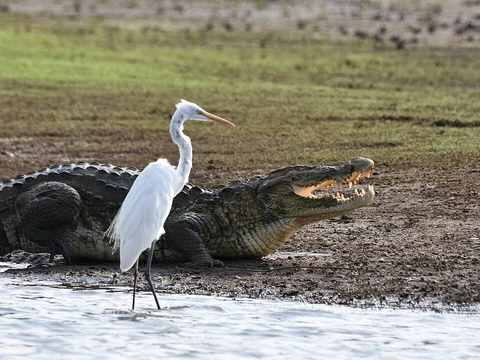
Crocodylia
Order of semiaquatic predatory reptiles, closest living relatives of birds.

Wikipedia / Wikimedia Commons
Crocodylia is an order of semiaquatic, predatory reptiles known as crocodilians, which appeared 83.5 million years ago in the Late Cretaceous period. They are the closest living relatives of birds, as the two groups are the only known survivors of the Archosauria. The order includes true crocodiles (family Crocodylidae), alligators and caimans (family Alligatoridae), and gharials and false gharials (family Gavialidae).
- born
- 83.5 million years ago (Late Cretaceous, Campanian stage)
- field
- Paleontology, Herpetology
- known_for
- Closest living relatives of birds; only surviving archosaurs alongside birds; includes crocodiles, alligators, caimans, and gharials
Lore & Background
Crocodylia is cladistically defined as the last common ancestor of Gavialis gangeticus (gharial), Alligator mississippiensis (American alligator), and Crocodylus rhombifer (Cuban crocodile) and all of its descendants. The three primary branches of Crocodilia had diverged by the Late Cretaceous. The possible earliest-known members may be Portugalosuchus and Zholsuchus from the Cenomanian-Turonian stages, though some researchers dispute the classification of Portugalosuchus, claiming it may be outside the crown-group crocodilians. Definitive alligatoroids first appeared during the Santonian-Campanian stages, while definitive longirostres first appeared during the Maastrichtian stage.
Reader's Guide
Crocodylia represents the crown group of modern crocodilians, restricted to the last common ancestor of today's species and all its descendants. Their evolutionary history extends back to the Late Cretaceous, with earlier pseudosuchian relatives appearing about 250 million years ago. Crocodilians are ectothermic, have four-chambered hearts and lungs with unidirectional airflow like birds, and are found in warm tropical areas of the Americas, Africa, Asia, and Oceania. They are generally solitary and territorial, though some hunt in groups, and females care for their hatched young. Human activities including hunting, poaching, and habitat destruction are the greatest threat to crocodilian populations, though farming has reduced unlawful trading in skins. Artistic and literary representations of crocodilians have appeared in human cultures since at least Ancient Egypt.
Did You Know?
- Crocodilians and birds are the only known survivors of the Archosauria.
- The name 'Crocodylia' may derive from Ancient Greek words meaning 'shingle' or 'pebble' and 'worm', possibly referring to the animal's habit of resting on pebbled shores.
- Alligators and caimans have broader U-shaped jaws that show only upper teeth when closed, while crocodiles have narrower V-shaped jaws with both rows visible.
- The oldest-known eusuchian is Hylaeochampsa vectiana from the Early Cretaceous, found on the Isle of Wight in the United Kingdom.
More in Extinct Archosaurs 1-24
Spotted an error? Know more?
This is a living reference — every entry is fact-audited, and reader corrections feed straight into our audit queue. Suggest an edit · See this site's audit record