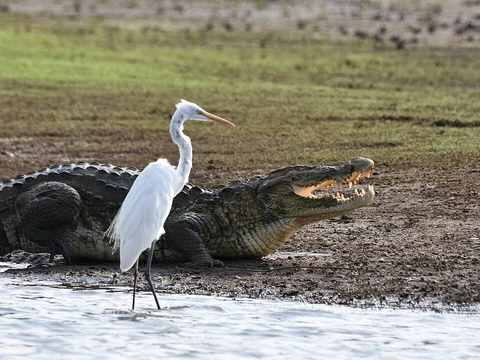
Dinosaur
Dinosaurs are warmblooded reptiles; birds are their only living descendants.
Dinosaurs are a varied group of warm-blooded reptiles belonging to the clade Dinosauria. They first showed up early in the Triassic period and, after the Triassic–Jurassic extinction event around 201.3 million years ago, became the dominant land animals. Their reign lasted through the Jurassic and Cretaceous periods. According to the fossil record, birds are feathered dinosaurs that evolved from earlier theropods in the Late Jurassic epoch, and they are the only dinosaur line to survive the Cretaceous–Paleogene extinction event roughly 66 million years ago. This means dinosaurs can be split into two groups: avian dinosaurs (birds) and the extinct non-avian dinosaurs (all dinosaurs except birds).
- first_appearance
- early Triassic period
- dominance_began
- after Triassic–Jurassic extinction event 201.3 mya
- extinction_of_non_avian
- Cretaceous–Paleogene extinction event approximately 66 mya
- field
- Paleontology
- known_for
- Dominant terrestrial vertebrates of the Mesozoic; birds are surviving dinosaurs
- number_of_non_avian_genera_identified
- over 900 (as of 2018)
- number_of_bird_species
- over 11,000 living species
Lore & Background
The first dinosaur fossils were recognized in the early 19th century, with the name 'dinosaur' (meaning 'terrible lizard') coined by Sir Richard Owen in 1842 to refer to these 'great fossil lizards'. Owen derived the term from Ancient Greek δεινός (deinos) 'terrible, potent or fearfully great' and σαῦρος (sauros) 'lizard or reptile', intending it to evoke their size and majesty. Through most of the 20th century, before birds were recognized as dinosaurs, most scientists presumed dinosaurs to have been sluggish and cold-blooded. Research since the 1970s has indicated that dinosaurs were active animals with elevated metabolisms and numerous adaptations for social interaction. Evidence shows that all dinosaurs had erect legs similar to birds and many mammals, as opposed to the sprawling leg stance of cold-blooded tetrapods. Some were herbivorous, others carnivorous. Evidence suggests that all dinosaurs were egg-laying, and that nest-building was a trait shared by many dinosaurs, both avian and non-avian.
Reader's Guide
Dinosaurs are significant as the dominant terrestrial vertebrates for most of the Mesozoic Era, and their only surviving lineage—birds—represents one of the most diverse groups of vertebrates today, with over 11,000 living species. The recognition of birds as dinosaurs revolutionized paleontology, shifting the understanding of dinosaur metabolism and behavior from sluggish, cold-blooded reptiles to active, warmblooded animals with complex social behaviors. Dinosaurs are represented on every continent by both extant species (birds) and fossil remains. Their large sizes and seemingly monstrous nature have ensured their regular appearance in best-selling books and films, such as the Jurassic Park franchise, leading to significant public funding for dinosaur science. Mounted fossil dinosaur skeletons are major attractions at museums worldwide. The study of dinosaurs continues to yield new discoveries, with over 900 non-avian genera identified and estimates suggesting many more remain undiscovered. Their legacy includes fundamental insights into evolution, extinction, and the interconnectedness of life on Earth.
Did You Know?
- Birds are the only dinosaur lineage known to have survived the Cretaceous–Paleogene extinction event approximately 66 mya.
- The term 'dinosaur' was coined by Sir Richard Owen in 1842 from Greek words meaning 'terrible lizard'.
- All dinosaurs had erect legs similar to birds and many mammals, not the sprawling stance of cold-blooded tetrapods.
- The largest sauropod dinosaurs are estimated to have reached lengths of 39.7 meters (130 feet) and heights of 18 m (59 ft).
More in Extinct Archosaurs 1-24
Spotted an error? Know more?
This is a living reference — every entry is fact-audited, and reader corrections feed straight into our audit queue. Suggest an edit · See this site's audit record