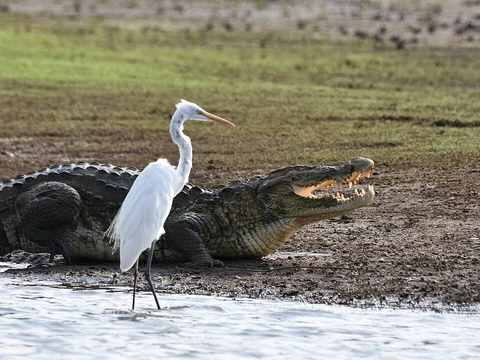
Feathered dinosaur
Dinosaurs with feathers, including all birds and many non-avian species.
Feathered dinosaurs are simply those that had feathers, which includes every bird species. Over the past few decades, evidence has grown that many non-avian dinosaurs also sported feathers or feather-like coverings, though scientists still debate just how widespread these features were across the whole dinosaur family tree.
One leading idea is that feathers first evolved for insulation, much like the down feathers on baby birds today, before later being adapted for flight. For most of the 1800s and well into the 1900s, dinosaurs were seen as close relatives of modern reptiles like lizards—the name "dinosaur" itself, coined in 1842 by Richard Owen, means "terrible lizard." That view started to change during the "dinosaur renaissance" of the late 1960s, and by the mid-1990s, strong evidence showed that dinosaurs are actually much more closely related to birds, which evolved directly from a group of theropod dinosaurs.
New fossil discoveries in the 2000s and 2010s, along with better technology for studying them, have greatly expanded knowledge of feather origins. Feathers or feather-like structures have now been found in dozens of non-avian dinosaur genera, mostly in coelurosaurian theropods, but also in at least three ornithischians. This suggests that the last common ancestor of the Ornithoscelida—a group that includes both theropods and ornithischians—might have had feathers. Even earlier origins are possible: vaned feathers have been found in pterosaurs, hinting that feathers may have first appeared in even more ancient archosaurs. Chemical analysis of feathers from the dinosaur *Sinosauropteryx* has revealed beta-proteins (formerly called beta-keratins), confirming that early feathers had a composition similar to modern bird feathers. Crocodilians also have beta-keratins like those of birds, pointing to a common genetic origin.
**History of research**
**Early**
Shortly after Charles Darwin published *On the Origin of Species* in 1859, biologist Thomas Henry Huxley argued that birds descended from dinosaurs. He compared the skeletons of the small theropod *Compsognathus* and the early bird *Archaeopteryx lithographica*, both from the Upper Jurassic limestone of Solnhofen, and showed that—aside from its hands and feathers—*Archaeopteryx* was very similar to *Compsognathus*, making it a transitional fossil. In 1868, Huxley published *On the Animals which
- field
- Paleontology
- known_for
- Possessing feathers or feather-like integument, linking dinosaurs to birds
- earliest_known_evidence
- Possible feather impressions in the 195–199 million year old Portland Formation
- key_fossil_sites
- Liaoning, China; Solnhofen, Germany; Myanmar amber deposits
Lore & Background
The concept of feathered dinosaurs emerged after the 1859 publication of Charles Darwin's On the Origin of Species, when Thomas Henry Huxley proposed that birds were descendants of dinosaurs. He compared the skeletal structure of Compsognathus and Archaeopteryx, showing their similarity, and in 1876 depicted a feathered Compsognathus. During the dinosaur renaissance starting in the late 1960s, paleoartists like Robert T. Bakker and Gregory S. Paul began restoring non-avian dinosaurs with feathers.
Reader's Guide
Feathered dinosaurs are significant because they provide direct evidence of the evolutionary link between non-avian dinosaurs and birds. Discoveries in the 2000s and 2010s, particularly from Liaoning, China, revealed dozens of genera with feather impressions, including theropods and at least three ornithischians, suggesting feathers may have been present in the last common ancestor of the Ornithoscelida. The discovery of vaned feathers in pterosaurs hints at an even earlier origin in archosaurs. Fossil feathers from Sinosauropteryx contain beta-proteins similar to modern bird feathers, and crocodilians share similar beta keratin, indicating common ancestral genes. Behavioral evidence, such as an oviraptorosaur on its nest with folded forearms, further links non-avian dinosaurs to birds. The function of early feathers likely was thermal insulation, as seen in down feathers of infant birds, before later modification for flight. Ongoing research continues to refine understanding of feather evolution and distribution among dinosaurs.
Did You Know?
- The first known specimen of Archaeopteryx was an isolated feather, though its attribution to the genus has been controversial.
- A feathered dinosaur tail preserved in amber, estimated to be 99 million years old, was discovered at an amber market in Myanmar.
- In 2011, amber samples from 75 to 80 million years ago contained preserved feathers from both dinosaurs and birds, some used for insulation.
- The 1999 fossil Archaeoraptor liaoningensis was found to be a forgery composed of two different fossil animals.
More in Extinct Archosaurs 1-24
Spotted an error? Know more?
This is a living reference — every entry is fact-audited, and reader corrections feed straight into our audit queue. Suggest an edit · See this site's audit record